
Local Vendor Spotlight: Cloverland Farm
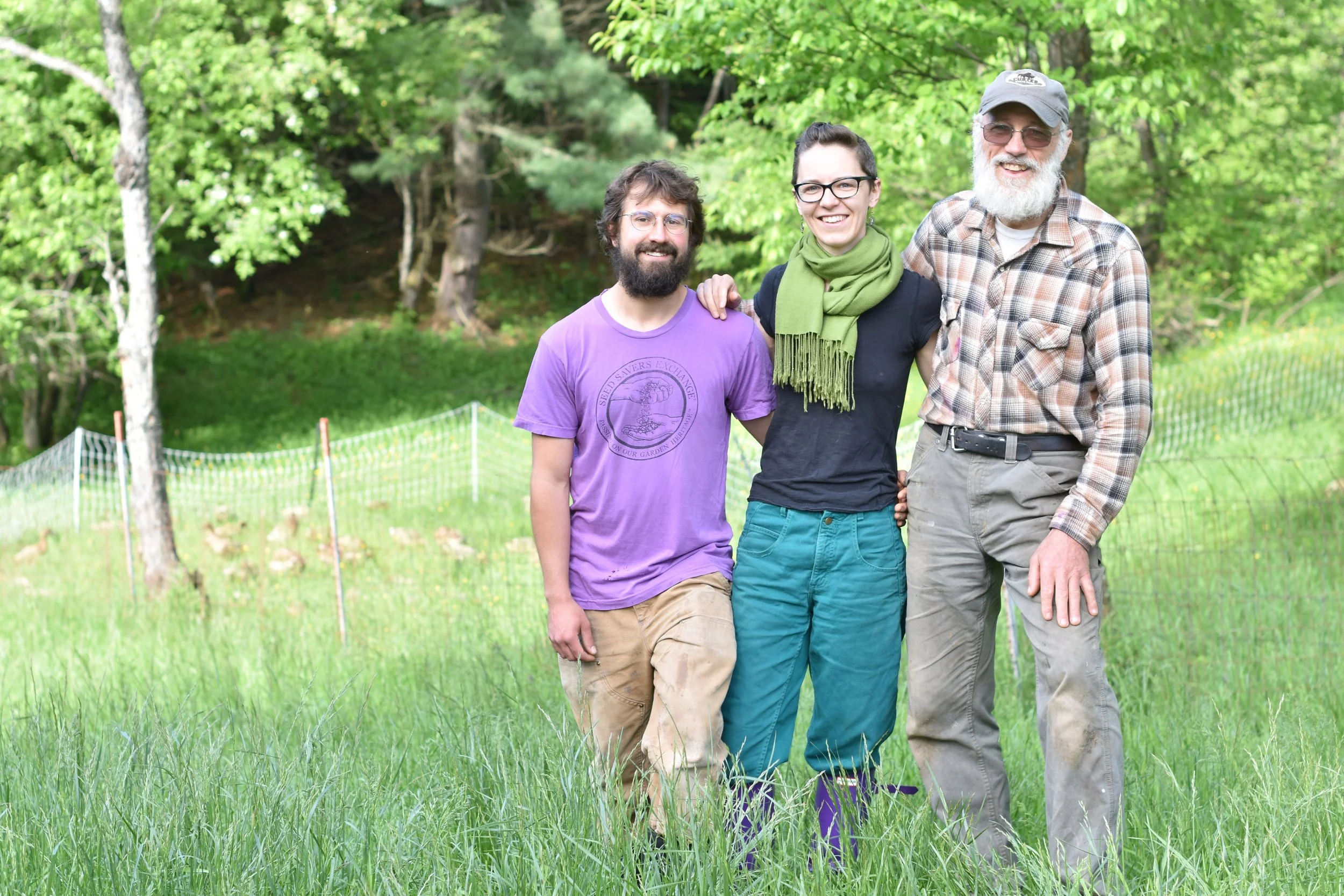
From left, Isaac Behrens, Hannah Behrens & Jim Murphy of Cloverland Farm
There’s an enchanting rhythm to life on a farm.
The mostly predictable daily structure of chores and rest; the physical, embodied work, where movement becomes muscle memory; the seasonal cycles of growth, abundance, and decay; the grounding balance of new life and death.
Every day follows a pattern, a cycle — but there’s observable change within the sameness. Weather shifts, animals behave differently, something breaks, something blooms. The balance of routine and rhythm with small, continuous shifts keeps it engaging.
It’s Isaac Behrens’ favorite part of his work at Cloverland Farm, a small, family-run egg operation on Old Little Lake Road in Marquette.
“I just love the rhythm of the work and the seasonality of things,” he said. “I’m doing the same things every day, but also every day is different. I have the opportunity to be more observant of what’s happening with the weather, the plants, and the animals around me. I’m grateful to see those day-to-day changes.”
That appreciation for farm life began in childhood, said Isaac. He spent time at his family’s small dairy farm in Wisconsin, where he enjoyed the cadence of chores and the steady responsibility of caring for animals. But as he got older, he realized his aunt and uncle had spent only one night away from the farm over several decades.
“Finding a life partner who is willing to do that, it’s a big ask,” said Isaac. The commitment seemed daunting at the time, so he decided to go a more traditional route, pursuing degrees in music and English. He imagined becoming a teacher, but still the idea of farming and a job working with his hands never left him. Fortunately, things fell into place when he found his wife Hannah and Cloverland.
Cloverland has been operating for more than 20 years, started by Isaac’s father-in-law, Jim Murphy. Isaac and Hannah took it over in 2020, with Jim still assisting regularly. Together, they tend a flock of about 1,000 laying hens, as well as some turkeys and feeder pigs, on 40 acres of forest and pasture.
2/3The typical day’s chores include filling feeders and waterers, cleaning and bedding down the nest boxes and coops, checking ventilation to ensure air quality, and making repairs.
“There is a lot of romanticizing of farming, but a lot of the time it’s just slog,” said Isaac. “The biggest lesson I’ve learned is how to get over my perfectionism some and understand it’s never going to be all done and it’s never going to be done perfectly.”
By mid-morning, they’ll start collecting eggs. “We get 2-4 baskets of eggs in the morning, and then collect again in the afternoon,” said Isaac. In total, the hens produce about 65 dozen eggs per day.
After they’re collected by hand, the eggs are washed, packed, and refrigerated under 45 degrees. They’re delivered to the Co-op within days and marked with a best-buy date one month out from when they were laid.
When raising chickens, ensuring a varied diet is the key to a healthy flock and quality egg production, said Isaac. While Cloverland’s flock consumes a conventional grain diet, it’s locally sourced. The grains are grown by UP farmers and purchased through Holmquist Feedmill in Trenary. Isaac also incorporates alfalfa, kelp, fishmeal, and food scraps to add more variety.
“We get them compost from local restaurants and the Co-op as much as we can, it helps keep them entertained and healthy,” said Isaac. “Some people are surprised that chickens are omnivores. They’re like little dinosaurs, they love a meat scrap or a grasshopper.”
They’re free-range, with year-round outdoor access, rotating through fenced pasture areas where they graze on greens, scavenge for bugs, and soak up sunshine that naturally supports strong shells and sturdy bones. Only when temperatures dip to around 10 degrees do they linger inside.
Prioritizing the chickens’ health is important to small farms like Cloverland, where profit isn’t the main driver.
“Industrial farms operate by externalizing costs – on the animals, the land, the workers. It’s not a just way to farm, and it’s not going to work in the long run.”
3/3 The birds are healthier and happier and, in turn, and produce better eggs, said Isaac. When chickens have a strong, diverse diet, and outdoor access, you’ll notice through the quality.
“You’re going to get thicker shells, sturdier whites, and yolks with a deeper orange color,” he said. “Those are signs of more nutrition and freshness.”
Keeping it small also allows the farm to operate at a human scale. Isaac and Hannah’s 2-year-old son, Hollis, can wander among the hens, “helping” collect eggs or weeding in the garden. The pace leaves room for learning, family, and shared work.
“Our work — me on the farm and Hannah working from home part-time as a clinical herbalist, teaching and consulting — gives us the flexibility to just be with (Hollis) more,” said Isaac. “He loves to pick up the chickens. He’s learned how to do it gently instead of chasing them. He calls them all ‘sweetie pie.’”
Cloverland also prioritizes the use of renewable energy as much as possible. The farm is off grid, said Isaac, and while they do have a generator to run appliances like their washing machine, most of their power is sourced from solar panels and a wind turbine on a 90-foot tower.
The challenges on the farm, Isaac views through a realistic lens. Rising costs, unpredictable weather, the occasional predator, working through the mixing of family and work relationships, are all things they just have to adjust to.
“It comes with the territory,” said Isaac. “But it gets easier each year as we tweak things and find what works for us.”
Throughout the years, Cloverland’s eggs remain in steady demand, supported and trusted by a community that values local food and partnerships that keep dollars circulating close to home. And so, the rhythm continues, with a crack of an egg that connects the farm to its neighbors.