
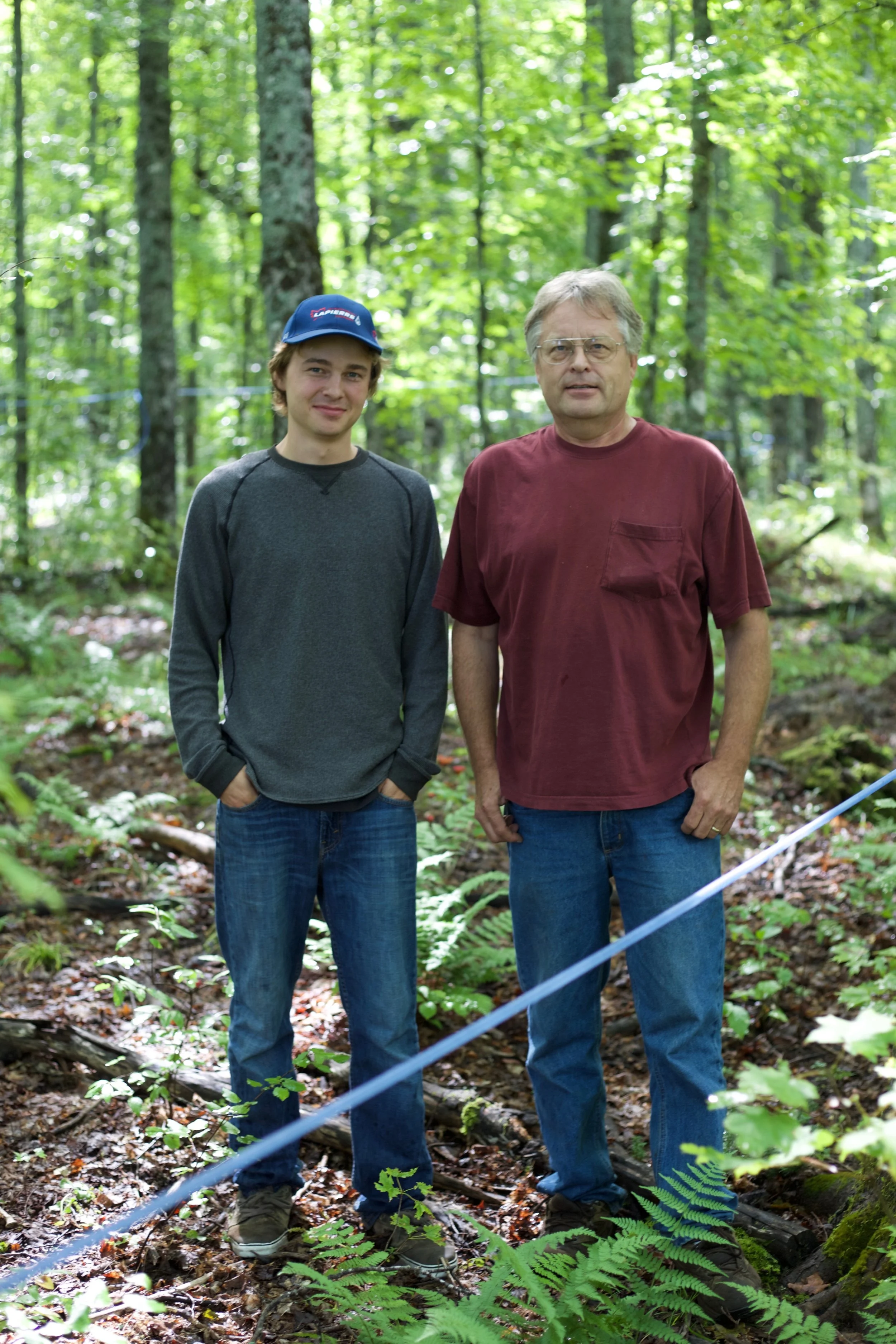
Bradley & Mark Danielson
Mark Danielson has been making and bottling maple syrup commercially for more than a quarter of a century, but his experience tapping trees and boiling sap goes all the way back to his childhood in L’Anse.
“In grade school, some kids on my block were making syrup in their backyard, so that’s where I got my start,” he said.
Many years later, he said he still gets that same nostalgic feeling when entering the woods during sugaring season, although the process looks a bit different now. He recalls memories of affixing plastic bags to the trees and hauling buckets of sap back to be processed. Today, Danielson’s Sugarbush uses a modern tubing system instead.
“Tubing is the way to do it,” he said. “We can’t be carrying five-gallon buckets through waist-deep snow.”
Sugaring is a family affair for the Danielsons — Mark works alongside his son, Bradley, and wife, Heidi, on their property in Nisula, a small farming community just west of Baraga. The region’s climate during the spring, with freezing temperatures at night and warmer days, is ideal for sap flow. The Danielsons’ property naturally consists mostly of maples, with a good mix of hard and soft maples, both of which can be tapped.
The process of turning sap into syrup has several steps. The first is tapping the tree. Mark and Bradley carefully drill a tap hole and a spout is inserted that directs the sap into the tubing system. The sap flows down a graduated series of lines into holding tanks in their sugar house, where it barely has time to settle before moving on to the next step.
“It’s like raw milk,” he said. “You have to process it the same day, or it spoils.”
From the collection tanks in the sugar house, the sap goes through a reverse osmosis machine that filters the sap, removing a large portion of the water and impurities, then into the evaporator, where it is boiled down into syrup.
They monitor the boiling process very closely. They know when it’s done not by the color, but by density, sugar content, and taste. The color can change drastically throughout the season and so can the intensity of the flavor.
“Color doesn’t always indicate the best flavor,” he said. “We go by taste, testing and experience to determine when it's ready. The timeline varies throughout the season, and testing is a constant part of the evaporation process.”
“Best-tasting” is a moving target. Different parts of the season produce different syrups. Early-season syrup is light in both color and flavor, thanks to sap that’s nearly pure sucrose. As bacteria naturally find their way into the sap, they convert some of that sucrose into glucose and fructose — sugars that darken and deepen flavor when boiled. Later in the season, more minerals from the trees add even richer notes.
The Danielsons take samples from each drum, often more than one, and go through and taste-test together.
“We taste every drum to see what we want to bottle under our own name. Sometimes Bradley and I disagree and need a third-party tiebreaker.”
Mark had a hard time describing the flavor he looks for — good syrup is just good syrup. For him, it’s self-evident. The taste is so fundamental and ingrained in him, it requires no description to be understood. It’s easier, he said, to describe “bad syrup.” It’s immediately obvious when the flavor is off and not up to their standard.
“If you go too long in the evaporator or wait too long into the season, it tastes bitter and burnt, like a tootsie roll,” he said. “We’re very particular with our syrup. I’ve noticed some people like to blend in off-flavored syrup into the better batches, but you can’t blend that off-flavor out. That's not something we do. We don’t want to ruin the good stuff, and we only bottle the best tasting syrup.”
Weather plays an important role, too. Maples can be finicky. They’re sensitive to temperature changes and need just the right conditions to produce. If a string of 70-degree days hits near the end of the season, the trees shift into their budding cycle. The sap changes composition and syrup can take on a notorious “buddy” flavor. It can still be a beautiful golden amber color, but as Mark said, color doesn’t tell us much. It’s all about the taste and the timing.
Finally, after the rigorous taste-testing, the syrup is filtered, hot packed into drums, and graded for flavor and color. Later, it’s reheated, bottled and moved to local retailers, sold individually or in bulk to other suppliers. The bulk buyers may repackage under another label or make value-added products, like granola, bacon, or baked goods.
The work doesn’t end when they hand off the finished product, though. People often assume sugaring is a seasonal occupation, but it’s a continuous process, said Mark.
“We are doing something every day with the business,” he said. “We almost never get a day off. If we’re not making the syrup or packaging the syrup, we’re managing the woods and preparing for the next season.”
In the “off-season,” they’re working on forest management before the snow hits again – thinning trees to improve forest health; clearing storm debris on and around the tubing system; performing equipment maintenance on tanks, pumps and other machinery; cleaning, repairing and replacing tubing damaged by weather and wildlife; and additional bottling and retail deliveries. Their woods, the syrup-making process, and the syrup are all certified organic, and Mark is responsible for maintaining that status by going through the organic inspection every year.
“When I purchased the property, it was going to be clear cut,” said Mark. “I was fortunate enough to find a property owner who saw a beautiful stand of maple trees and was happy to see it utilized differently. We honor that by maintaining the health of the trees and the woods.”
While Mark said the work is enjoyable, and providing a high-quality local and organic product to his customers is fulfilling, the challenges have grown over the years. Land is expensive and there’s not much available, so there isn’t really room for expansion. Loggers compete for the same trees. Plus, everything — fuel, equipment, supplies, retail containers shipped from the East Coast — now costs more.
Annually, their production depends on what Mother Nature provides. It takes an average of 40 gallons of sap to make one gallon of syrup, so the volume of sap that moves through the operation is substantial. They’ve made other products like maple candy, maple cream and maple sugar, and each summer they spin maple cotton candy for the Chassell Strawberry Festival. But mostly, they stick to what they love, just the syrup.
“It doesn’t feel like work most of the time. I’m my own boss, and I really like doing it. And when I’m ready, I'm hoping that Bradley wants to continue the tradition that we've worked so hard to create,” said Mark.
The Co-op carries Danielson’s Sugarbush maple syrup in various sizes, both in glass and plastic bottles.